Arabic AI Chatbots and WhatsApp Agents for UAE and Saudi Businesses: 2027 Implementation Guide
Arabic support is now the baseline in the Gulf. Learn which Arabic AI chatbot use cases pay back, how to handle Khaleeji, Saudi dialects, Arabizi and voice notes, which models to use, WhatsApp rules for 2026-2027, and how to prove dialect quality before launch.
Himanshu
PRINCIPAL ARCHITECT11 MIN READ
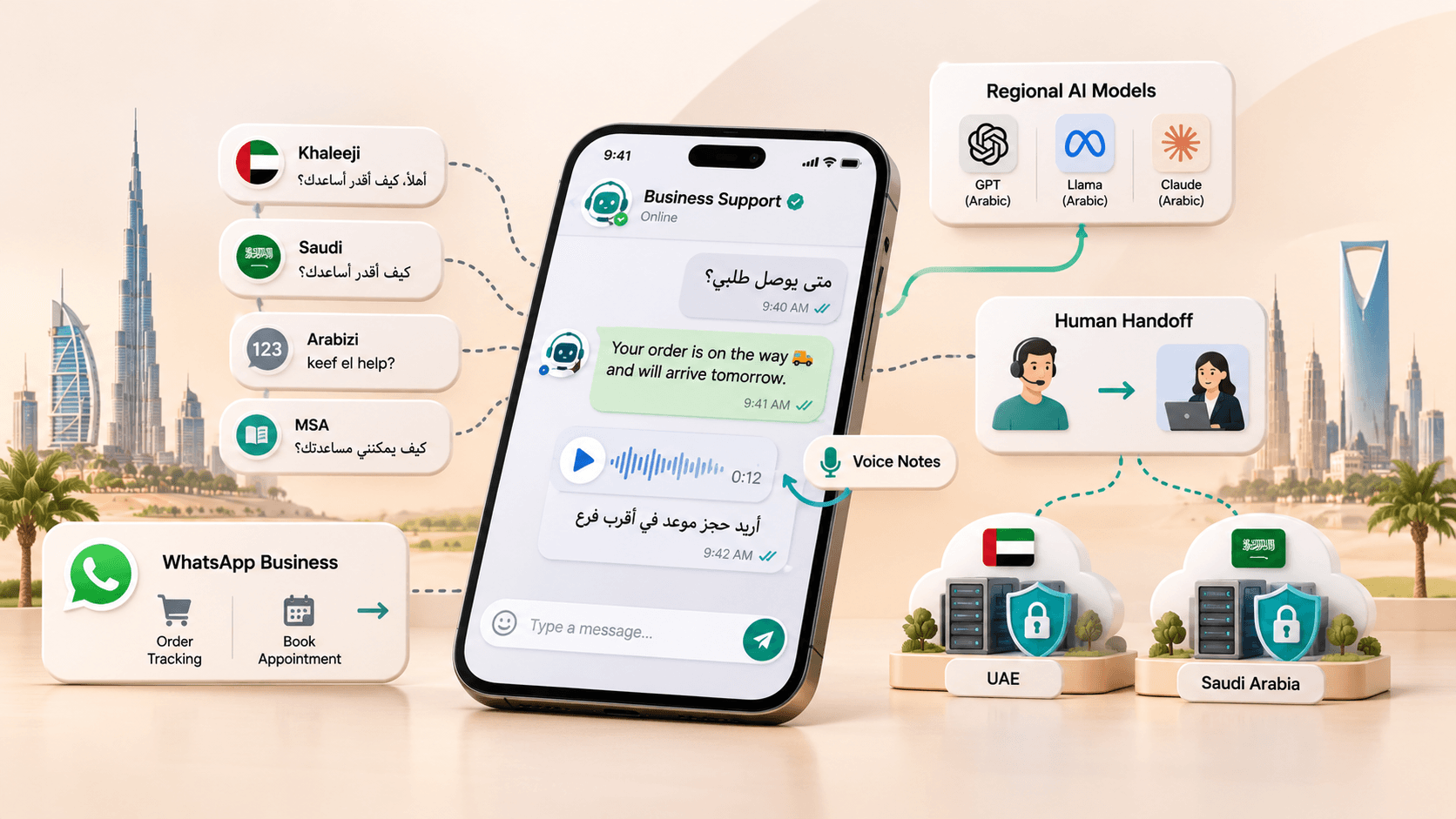
An Arabic AI chatbot for UAE and Saudi businesses is a bilingual (Arabic and English) assistant that understands Gulf dialects, Arabizi and voice notes, answers from your own data, and runs on WhatsApp, web and apps with a clean handover to human agents. A focused production build usually takes 8 to 14 weeks. The difference between a good and a bad one is not "Arabic support" but dialect quality, grounded answers, WhatsApp policy compliance and in-region data handling.
Two years ago, a working Arabic chatbot set a brand apart in Dubai or Riyadh. In 2027 it is the baseline. Infobip reports that banks in the UAE and Saudi Arabia already automate 60 to 70% of routine Arabic queries such as balance checks, card activation and statement requests. Customers now judge your bot on a harder test: does it understand how they actually write and speak?
That test is tougher than most vendors admit. In August 2026, MBZUAI's ArabCulture-Dialogue benchmark found that leading models pick the culturally correct reply in the mid-90% range, but generate the right national dialect only about half the time, with Emirati among the hardest. This guide covers the use cases that pay back, the dialects you must plan for, which Arabic models to consider, WhatsApp rules for 2026 and 2027, a delivery roadmap, and how to prove quality before launch. If you need full pricing tables, see our AI chatbot development cost guide.
Why "Arabic Support" Is No Longer Enough in 2027
Most off-the-shelf platforms tick an "Arabic" box by translating English flows into Modern Standard Arabic (MSA). Real Gulf customers rarely write in MSA. They type in Khaleeji or Saudi dialect, switch to English mid-sentence, use Arabizi ("shlonak", "7abibi", "ab3at"), and send voice notes. A bot trained only on MSA misreads intent, replies in a stiff register, and pushes customers to call your contact centre anyway.
Three shifts make 2027 the year to fix this:
Better Arabic models. G42's Inception and MBZUAI launched Jais 3 in October 2026, with a speech model that identifies dialects from 19 Arab countries and keeps English terms in their original script. Saudi Arabia's HUMAIN runs ALLaM 34B, and TII released Falcon-H1 Arabic in January 2026.
WhatsApp is the front door. More than 80% of people in both the UAE and Saudi Arabia use WhatsApp (We Are Social, Digital 2026). If your bot is not on WhatsApp, most customers will not find it.
Government momentum. The UAE aims to introduce agentic AI across 50% of federal government sectors and services within two years, which raises customer expectations for private brands too.
Arabic AI Chatbot Use Cases That Pay Back Fastest
Start where query volume is high, answers live in your systems, and mistakes are easy to catch. These are the use cases we see deliver within the first quarter of going live.
Industry | Use case | Best channel | What to measure |
|---|---|---|---|
Banking and fintech | Balance, card activation, statement requests, dispute intake | App chat, WhatsApp | Containment rate, authenticated session success |
Real estate | Lead qualification, viewing bookings, payment plan questions in Arabic and English | WhatsApp, website | Qualified leads, booked viewings |
Healthcare clinics | Appointment booking, insurance coverage checks, pre-visit instructions | WhatsApp, app | No-show rate, call volume reduction |
Retail and e-commerce | Order tracking, returns, product questions, chat commerce | WhatsApp, Instagram DM | Conversion from chat, cart recovery |
Government and semi-government | Service eligibility, document checklists, application status | Web portal, app | First contact resolution, CSAT |
Logistics and delivery | Where is my order, address clarification, delivery rescheduling | WhatsApp, voice | Failed delivery rate, agent minutes saved |
HR and internal teams | Policy questions, leave balance, onboarding for bilingual staff | Teams, Slack, intranet | HR ticket reduction |
Notice the pattern: each use case is tied to a specific business function. That matters for WhatsApp compliance, which we cover below.
The Dialects and Inputs Your Chatbot Must Actually Handle
"Arabic speakers are not one uniform audience," as Infobip's regional team puts it. Plan your bot around who writes to you, not around a language label.
Modern Standard Arabic (MSA): Formal messages, government and legal contexts, and the safest register for replies when the dialect is unclear.
Khaleeji and Emirati: Core for UAE consumers. Emirati is one of the hardest dialects for current models to generate, so test it explicitly.
Saudi dialects (Najdi, Hijazi, others): Riyadh and Jeddah customers phrase the same request differently. Your evaluation set should include both.
Egyptian and Levantine: A large share of Gulf residents and service staff use these. Ignoring them hurts both customer and internal bots.
Arabizi: Arabic written in Latin letters and numbers (3 for ع, 7 for ح). Very common among younger users on WhatsApp.
Code-switching: "Abgha a cancel the order" or "ابي اغير الـ delivery slot". Your bot must keep English product names and order IDs intact.
Voice notes: Many Gulf customers prefer speaking to typing. A WhatsApp bot that ignores voice notes forces a channel switch.
Practical rule: understand every dialect, but reply in a consistent, polite Gulf-friendly register (light Khaleeji or simplified MSA) unless you have tested dialect generation for that market. Tone matters: too casual can read as disrespectful, too formal feels distant.
Which Arabic AI Model Should Power Your Chatbot?
There is no single best model. The right choice depends on data residency, dialect needs, cost and how much reasoning the bot must do. Most production systems we build use a router: a strong general model for complex reasoning, plus a smaller or Arabic-centric model for high-volume, simple turns.
Option | Strengths | Watch out for | Best fit |
|---|---|---|---|
Frontier models (GPT, Claude, Gemini families) | Strong reasoning, tool use and understanding of dialect input | Dialect generation still uneven; check data residency terms and regional hosting | Complex support, agentic workflows |
Jais 3 (Inception, MBZUAI) | Open weights, six sizes from 0.9B to 375B parameters, Arabic speech with dialect ID | Benchmarks show a gap to top closed models on some tasks; needs your own hosting | UAE data residency, voice-first bots |
ALLaM (HUMAIN, Saudi Arabia) | Built locally for Arabic and Saudi context, powers HUMAIN Chat | Availability and licensing terms vary by deployment | KSA public sector and regulated industries |
Falcon-H1 Arabic (TII) | Efficient open model with Arabic focus, good for self-hosting | Requires fine-tuning and evaluation for your domain | Cost-sensitive, high-volume bots |
Open multilingual models (Qwen, Gemma families) | Low cost, flexible hosting | Smaller models can be near random on dialect tasks per MBZUAI tests | Classification, routing, simple FAQs |
One finding from the MBZUAI benchmark is worth acting on: telling the model the customer's country and region improved dialect accuracy. A simple system prompt that passes "customer location: Riyadh" or "Dubai" is a cheap quality win. For answers that must be factually correct, ground the model in your own documents with retrieval. Our RAG knowledge assistant guide explains how.
WhatsApp Rules to Design Around in 2026 and 2027
WhatsApp is the default channel in the Gulf, and Meta has tightened its rules. Build these in from day one.
No general-purpose AI assistants. Since January 15, 2026, Meta's WhatsApp Business terms bar open-ended, assistant-style chatbots on the Business Platform. Bots that serve a clear business function, such as support, bookings, order tracking and sales, remain allowed. Scope your Arabic bot tightly to your business and decline unrelated requests politely.
Clear human handoff. Give customers a way to reach a person in the same chat, with full context passed to the agent so they do not repeat themselves.
Pricing changes. Meta's pricing updates from October 1, 2026 affect service and utility messages at volume. We broke down the numbers in our chatbot cost guide.
Template approval in Arabic. Outbound messages need approved templates. Submit Arabic and English versions together and keep variables (names, order IDs) outside Arabic text to avoid right-to-left rendering issues.
Voice notes and media. Plan speech-to-text for Arabic voice notes and handle shared locations and catalog items rather than asking customers to resend them.
Implementation Roadmap: From Pilot to Production in 8 to 14 Weeks
Phase | Duration | Key outputs |
|---|---|---|
1. Discovery and conversation audit | 1 to 2 weeks | Top 30 to 50 intents from real chat and call logs, dialect mix by channel, success metrics |
2. Knowledge and data preparation | 1 to 2 weeks | Bilingual knowledge base, Arabic glossary (product names, transliterations), evaluation set of 300 to 500 real messages |
3. Build and integrate | 3 to 6 weeks | Model routing, retrieval, WhatsApp and web channels, CRM or helpdesk integration, human handoff |
4. Dialect QA and red-teaming | 1 to 2 weeks | Native-speaker review across Emirati, Saudi, Egyptian and Levantine samples, Arabizi and voice tests, safety tests |
5. Soft launch and tuning | 2 weeks | Live on a share of traffic, low-confidence review queue, weekly prompt and content fixes |
A pilot on one channel with 10 to 15 intents can be live in 4 to 6 weeks. Multi-channel bots with deep system integrations or agentic actions (refunds, bookings, account changes) sit at the upper end. For bots that take actions inside your systems, see our agentic AI services.
How to Measure Arabic Dialect Quality Before Launch
Ask any vendor for these numbers on your own data, not a demo script.
Metric | What it tells you | Sensible launch target |
|---|---|---|
Intent accuracy by dialect | Does the bot understand Emirati, Saudi, Egyptian and Arabizi equally well? | 90%+ on each major dialect in your traffic |
Grounded answer rate | Share of answers backed by your approved sources | 95%+ for policy, pricing and medical or financial content |
Register and tone score | Native reviewers rate politeness and naturalness on a 1 to 5 scale | 4+ average |
Containment rate | Conversations resolved without a human | 40 to 70% depending on use case |
Escalation quality | Handoffs that reach the right team with full context | 95%+ |
CSAT by language | Do Arabic users rate the bot as highly as English users? | Within 5 points of English CSAT |
Keep the evaluation set and re-run it every time you change the model or prompts. Model updates can quietly improve English while degrading a specific dialect.
Compliance and Data Residency in the UAE and Saudi Arabia
UAE: The Personal Data Protection Law (Federal Decree-Law No. 45 of 2021) governs consent and cross-border transfers. Sector regulators add more: the Central Bank for financial services, and health authorities (DHA, DoH) plus Federal Law No. 2 of 2019 for health data, which restricts storage outside the country. Free zones such as DIFC and ADGM have their own data protection regimes.
Saudi Arabia: The PDPL, enforced by SDAIA since September 14, 2024, sets strict conditions on transferring personal data outside the Kingdom. Government and regulated sectors also follow NCA cybersecurity controls. Many KSA clients now prefer in-Kingdom hosting for both the model and the logs.
AI disclosure and audit trails: Regulators in banking, healthcare and government increasingly expect you to tell customers they are talking to AI, keep logs of AI responses, and route sensitive issues to humans.
Design choice that saves pain later: keep customer identifiers out of prompts where possible, store conversation logs in-region, and choose models that can run in UAE or KSA cloud regions or on your own infrastructure.
Serving Arabic Speakers in the UK, USA, Canada and Australia
Arabic AI chatbots are not only a Gulf project. UK and US banks, telecoms, universities, healthcare providers and travel brands serve large Arabic-speaking communities and Gulf visitors. The dialect mix there leans more Levantine, Egyptian, Iraqi and North African, so retune your evaluation set for that audience. Compliance follows the local regime: UK GDPR, US state privacy laws and HIPAA for health data, PIPEDA in Canada, and the Privacy Act in Australia.
Budget at a Glance
We keep detailed pricing in our 2027 chatbot cost guide, but as a planning range:
Single-channel Arabic pilot: $2,000 to $12,000, 4 to 6 weeks.
Bilingual production chatbot (WhatsApp plus web, CRM, handoff): $5,000 to $70,000, 10 to 14 weeks.
Running costs: roughly $50 to $6,000 per month depending on message volume, model choice, WhatsApp fees and hosting.
Common Mistakes to Avoid
Translating English flows into MSA instead of designing from real Arabic conversations.
Testing only with internal staff who write cleaner Arabic than customers do.
Building a general assistant on WhatsApp that breaks Meta's business-function rule.
Ignoring voice notes and Arabizi, which are a big share of Gulf WhatsApp traffic.
No owner after launch. Arabic bots need monthly review of low-confidence conversations and new slang.
How iSkylar Builds Arabic AI Chatbots
iSkylar's AI chatbot development team builds bilingual Arabic and English assistants grounded in your data with retrieval, connected to WhatsApp Business, web, apps, Salesforce, HubSpot, Zendesk and custom systems. You own the configuration, training data, conversation logs and integration code. For Vengo AI, our 24/7 AI sales agent produced a 3x increase in qualified leads. For more complex generative AI work, see our generative AI development services.
Ready to Launch an Arabic AI Chatbot Your Customers Trust?
Tell us your top customer questions and channels, and iSkylar will map the dialect mix, model options and a fixed-scope roadmap within 48 hours. Talk to our Arabic AI chatbot team.
WRITTEN BY
Himanshu
Head of Marketing & Growth at iSkylar, where he helps founders and enterprise teams plan, price and launch AI and mobile products across the US, UK, Canada, Australia and the Middle East.
Frequently Asked Questions
Can AI chatbots understand Saudi and Emirati dialects?
What is the best AI model for an Arabic chatbot?
Are AI chatbots allowed on WhatsApp in 2026 and 2027?
Can an Arabic chatbot handle voice notes and Arabizi?
How long does it take to build an Arabic AI chatbot?
Does my Arabic chatbot data need to stay in the UAE or Saudi Arabia?
How much does an Arabic AI chatbot cost?
Further Reading
Stay at the forefront of innovation.
innovation.
Join our inner circle of industry leaders and get exclusive insights delivered to your inbox every Thursday morning.
WE RESPECT YOUR PRIVACY. NO SPAM, EVER.
Updated At: