
Cost to Build an E-Wallet App in the USA?
A 2026 cost breakdown for building an e-wallet app in the USA, covering wallet types, features, PCI DSS compliance, developer rates, and total budget ranges.
Harsh Singh
PRINCIPAL ARCHITECT10 MIN READ
The Real Answer, Upfront
If you are planning to build an e-wallet app in the USA in 2026, you should budget anywhere from $30,000 for a basic MVP to well over $300,000 for a fully featured, enterprise-grade platform. Most production-ready apps with standard payment, KYC, and security features fall in the $60,000 to $150,000 range when built by a US or hybrid development team. The exact number depends on wallet type, feature depth, compliance scope, and where your development team is based and in this guide, we break down exactly why.
Digital wallets are no longer a fintech side project they are core infrastructure. The U.S. mobile wallet user base is projected to surpass 180 million by 2026, and digital wallet transactions worldwide are projected to reach $16 trillion by 2028. For founders and businesses entering this space, understanding true cost drivers not just headline numbers is essential to budgeting realistically and avoiding costly surprises mid-build.
E-Wallet App Cost by Type and Complexity
Not all e-wallets are built the same way, and cost scales directly with the regulatory and technical complexity of the wallet model you choose.
Closed-Loop Wallets
Closed wallets work only within a single merchant ecosystem think a branded retail or coffee-shop app where balance can only be spent with that business. These are the least complex and least regulated wallet type, since funds never leave a closed network. A closed-loop MVP typically starts at $15,000 to $35,000.
Semi-Closed Wallets
Semi-closed wallets allow transactions across a network of multiple affiliated merchants rather than a single brand. This requires additional integration work with partner systems and more robust transaction reconciliation, typically pushing budgets into the $35,000 to $100,000 range.
Open-Loop Wallets
Open wallets offer full banking-style functionality deposits, withdrawals, peer-to-peer transfers, and card issuance through partners like Marqeta or Galileo. This is the most expensive and most regulated category, generally starting around $60,000 and frequently exceeding $200,000 to $300,000+ for enterprise-grade platforms, due to the extensive compliance, security, and banking-partner integration work involved.
What Actually Drives the Cost
Core Features and Functionality
Every additional capability peer-to-peer transfers, in-app purchases, subscription billing, bill splitting, or loyalty integrations adds development hours. A baseline e-wallet typically needs account registration and KYC verification, secure login and authentication, fund top-up and withdrawal, transaction history, QR or NFC-based payments, and push notifications. Each additional workflow beyond this baseline meaningfully increases scope, so feature prioritisation for your first release is one of the most effective ways to control cost.
Regulatory Compliance
Compliance is the single most underestimated cost driver in fintech app development. For an app handling cardholder data, PCI DSS compliance alone typically adds $15,000 to $50,000 in initial implementation, plus annual recertification and audits. KYC/AML identity verification, sanctions screening, and ongoing transaction monitoring add further engineering and third-party vendor costs. Combined, regulatory compliance commonly adds 20 to 40 percent to a fintech app’s total development budget a figure too many early cost estimates leave out entirely.
Security and Fraud Prevention
Beyond baseline compliance, AI-powered fraud detection has become a near-standard expectation rather than a luxury add-on, typically adding $30,000 to $50,000 to build costs. Penetration testing ahead of launch generally runs $15,000 to $25,000 per audit, and is a non-negotiable step before handling real customer funds.
Third-Party Integrations and Banking-as-a-Service Fees
Open-loop wallets that issue cards or move money between banks typically rely on Banking-as-a-Service (BaaS) providers. These providers commonly charge $2,000 to $15,000 per month in mandatory platform fees an ongoing operating cost that sits outside the one-time development budget but must be planned for from day one.
Development Team Location
Where your engineering team is based has the single largest impact on total project cost. In the USA, senior mobile and fintech engineers typically charge $120 to $250 per hour, with fintech-specialist rates often sitting toward the higher end given the compliance expertise required. Western European teams run roughly $90 to $200 per hour, while experienced Eastern European teams particularly in Poland and Ukraine charge $45 to $90 per hour with strong familiarity with PCI DSS, PSD2, and KYC/AML frameworks. Offshore teams in South Asia, including India, typically range from $20 to $70 per hour, offering the most cost-efficient route for businesses willing to manage a fully remote engagement.
Estimated Cost Breakdown by Project Size
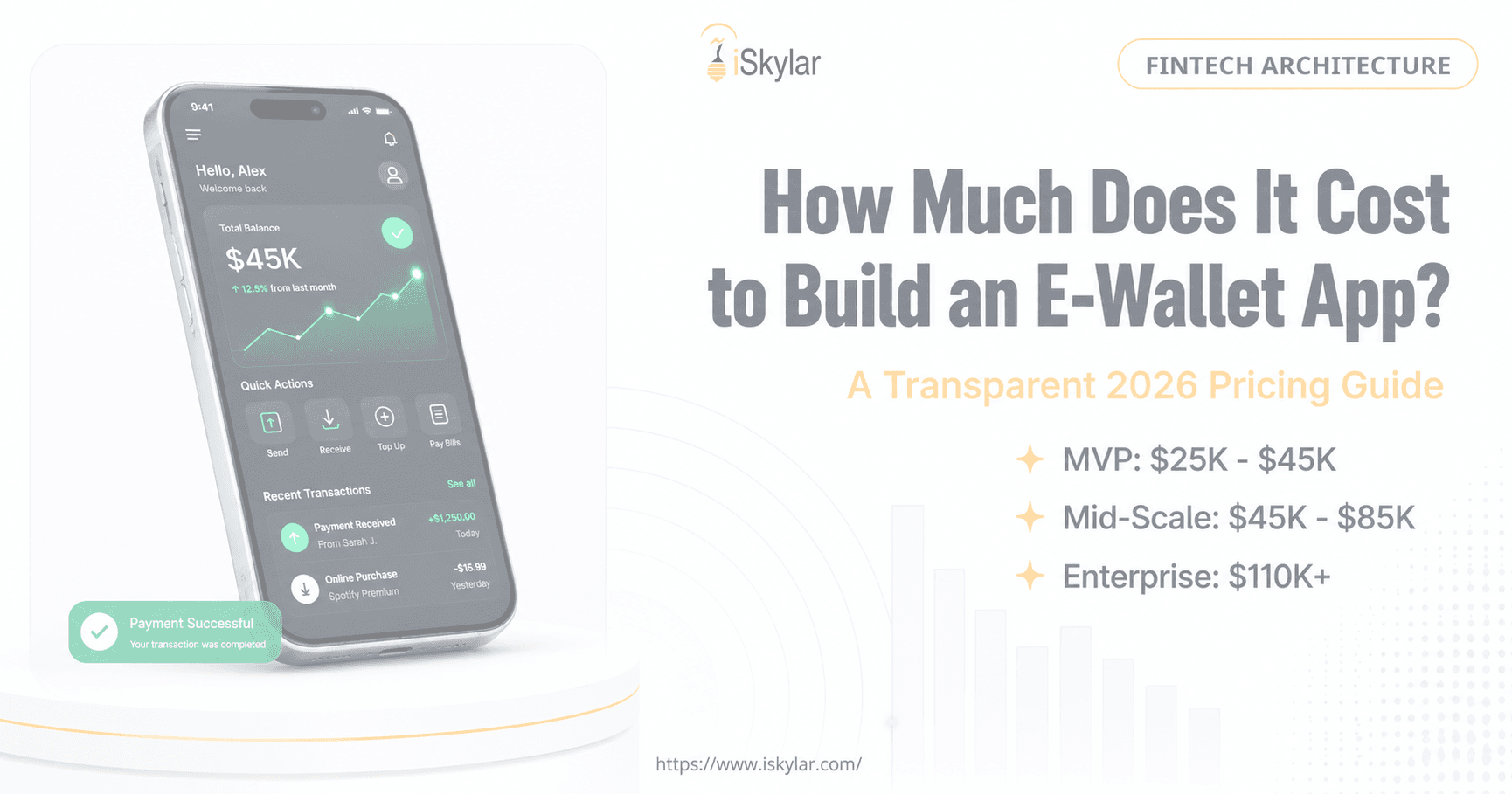
Basic MVP Wallet — $15,000 to $35,000. Covers registration, KYC, basic payments, and transaction history. Suitable for validating a single-merchant or closed-loop concept.
Medium-Complexity Wallet — $35,000 to $100,000. Adds peer-to-peer transfers, multiple payment methods, promotions, and richer compliance coverage for a semi-closed or early open-loop model.
Large, Enterprise-Grade Wallet — $100,000 to $300,000+. Full open-loop banking functionality, card issuance, AI-driven fraud detection, multi-region compliance, and integrations with core banking and BaaS partners.
For context, a standard fintech MVP with KYC, payments, and basic dashboards typically lands between $120,000 and $200,000 when built with a mid-priced offshore or nearshore partner a useful benchmark for US founders comparing vendor quotes.
Timeline Expectations
Development timelines scale alongside cost and complexity. A basic MVP wallet typically takes 2 to 4 months to build and launch. A medium-complexity wallet generally requires 4 to 6 months, accounting for additional integrations and compliance review. Enterprise-grade, fully compliant open-loop wallets commonly take 6 to 12 months, particularly when factoring in banking-partner onboarding, security audits, and PCI DSS certification cycles that run in parallel with engineering work.
Hidden Costs Founders Often Miss
The sticker price quoted by a development vendor rarely captures the full cost of operating an e-wallet. Budget for the following ongoing line items beyond the initial build:
Annual PCI DSS recertification — typically $20,000 to $50,000 per year depending on transaction volume
BaaS platform fees — $2,000 to $15,000 per month for card issuance and banking rails
Ongoing app maintenance — generally 15 to 20 percent of the original build cost annually, covering OS updates, SDK migrations, and bug fixes
Security audits and penetration testing — recurring assessments as transaction volume and feature scope grow
Treating these as one-time costs rather than ongoing operating expenses is one of the most common budgeting mistakes founders make when entering the e-wallet space.
How to Control Costs Without Cutting Corners
The smartest way to manage e-wallet development costs is not to chase the cheapest hourly rate it is to scope deliberately. Start with a tightly defined MVP covering only the features essential to prove your core value proposition: registration, KYC, fund top-up, and basic payments. Use a hosted, tokenized payment processor rather than handling raw card data directly wherever possible, since this can dramatically reduce your PCI DSS compliance scope and cost. Choose a development partner with proven fintech and compliance experience from day one rework caused by a team unfamiliar with KYC/AML or PCI requirements is consistently more expensive than paying a slightly higher rate upfront for specialists who get it right the first time.
Why Work with iSkylar Technologies
Building a secure, compliant e-wallet app is a high-stakes undertaking the cost of getting security or compliance wrong far exceeds the cost of doing it properly from the start. iSkylar Technologies designs and builds fintech applications with PCI DSS compliance, robust KYC/AML workflows, and fraud-resistant architecture built in from day one, not bolted on after launch. We work with founders and established financial institutions across the USA, UK, Australia, and Canada to deliver e-wallet platforms that are secure, scalable, and built to pass regulatory scrutiny.
Ready to scope your e-wallet app with accurate, transparent pricing? Contact iSkylar Technologies today for a detailed cost estimate tailored to your specific wallet model and compliance requirements.
WRITTEN BY
Harsh Singh
Senior Technical Content writer having 10 years of experience
Further Reading






Stay at the forefront of innovation.
innovation.
Join our inner circle of industry leaders and get exclusive insights delivered to your inbox every Thursday morning.
WE RESPECT YOUR PRIVACY. NO SPAM, EVER.