
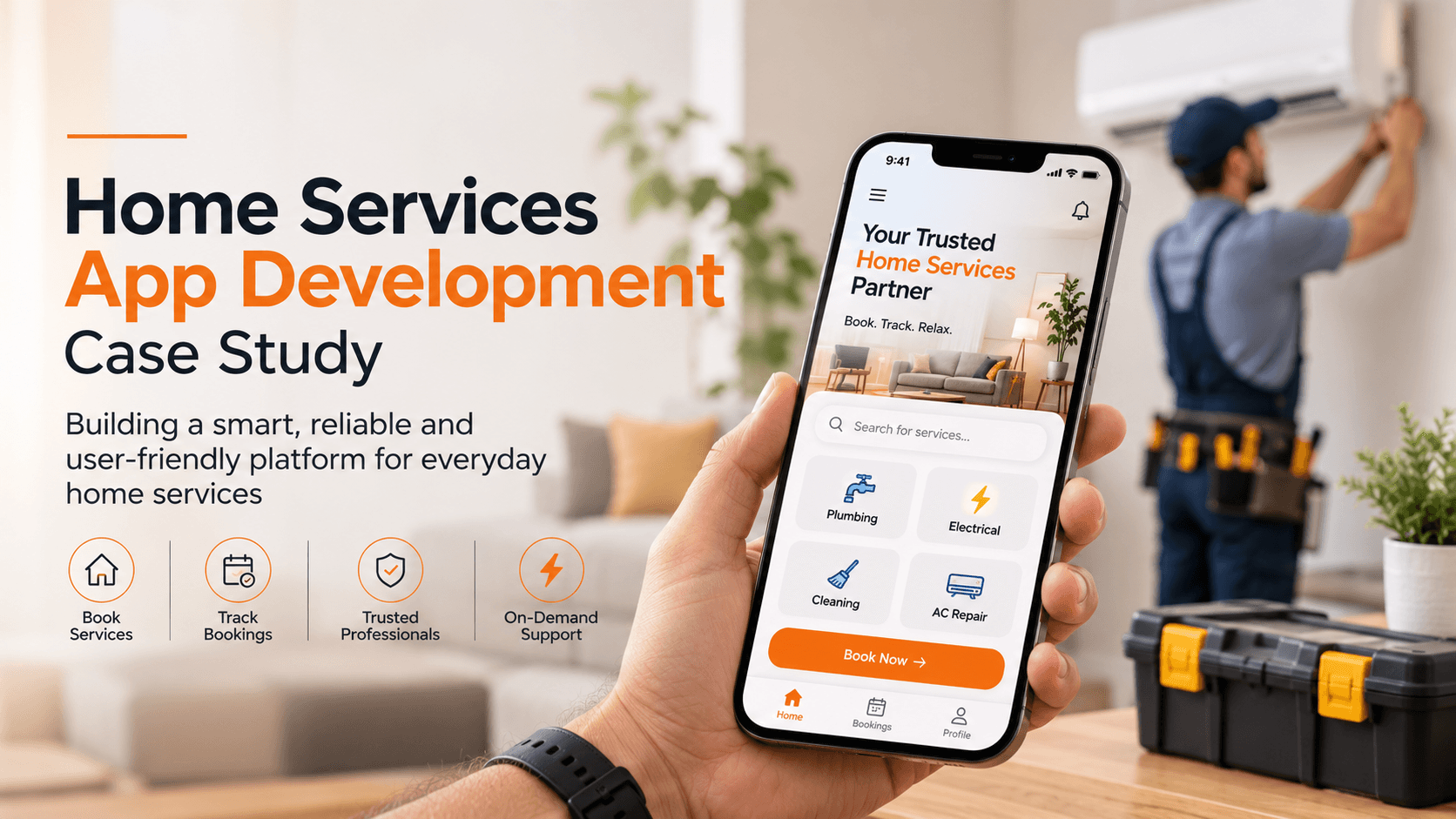
How We Built the App That Carried a Home Services Startup to 100K+ Downloads
How iSkylar handled home services app development for an on-demand startup: customer app, service provider app and admin dashboard, scaled to 100K+ downloads and 300+ services.
100K+
App Downloads
300+
Bookable Services
Multi-City
Operations on One Platform
3 Years
Featured by Apple
A home services startup had a service customers trusted and a network of local professionals ready to work. What it did not have was a platform that could handle hundreds of service types, thousands of bookings and growth into new cities. iSkylar took on the home services app development: a customer app, a service provider app and an admin dashboard on one backend. The result was an on-demand home services app that passed 100K+ downloads, listed 300+ bookable services and was featured by Apple three years in a row.
A proven service with no platform behind it
The founders had done the hard part first. In a market where most home repairs were arranged by word of mouth and settled by haggling at the door, they had recruited plumbers, electricians, cleaners, carpenters and AC technicians, checked them, and set clear standards for how jobs should be done. Households were paying for it and coming back.
Growth exposed the gap. Bookings arrived by phone and message, jobs were matched by hand, and every new service or neighbourhood added more manual work. The team was spending its days dispatching instead of building the business. They needed to build a home services app that could take over that work, give customers a booking experience they would choose over a phone call, and keep pace with expansion.
They brought in iSkylar as their home service app development company to design and build that platform.
Three problems the platform had to solve
A catalogue of more than 300 services
This was a multi-service home services app, not a short menu of repairs. It covered pest control, AC repair, CCTV fixes, car washes, appliance repair, furniture assembly, deep cleaning and hundreds more. Each service carried its own pricing, job length and type of professional, yet customers needed to find the right one in seconds.
Two very different users
Customers wanted speed and certainty. Professionals, many using a smartphone for work for the first time, needed something they could learn in minutes on a mid-range Android phone with patchy data. A single app could not serve both well.
Growth across cities
The business planned to expand quickly. Every new city would bring its own service areas, prices and pool of professionals. If each launch required new development, the technology would become the brake on growth.
What we built
We split the platform into three connected products running on one shared backend, so a booking, a job and a payment are always in sync wherever they are viewed.
Product | Used by | What it does |
|---|---|---|
Customer app (Android and iOS) | Households | Browse the service catalogue, see upfront pricing, book and schedule, follow the job, pay in the app, and leave ratings and reviews |
Service provider app | Professionals | Receive job alerts, accept and schedule work, navigate to the customer, update job status and see earnings |
Admin dashboard | Operations team | Manage services, prices, cities, service areas, provider verification, bookings, refunds and quality |
Treating these as three separate products, rather than one home services app with service provider app screens bolted on, was the decision that shaped everything else.
A booking flow that hides 300+ services
Customers choose a problem, not a line item. We grouped the service catalogue into a small set of top-level categories with guided options that describe what is wrong, such as "AC not cooling" or "kitchen tap leaking". The backend maps each choice to the right service, price and type of professional. Search sits on top for customers who already know what they need.
The app design had one target: a booking in under a minute, whichever service it is for. Plain language replaced trade terms, and sensible defaults, such as the nearest free time slot, removed decisions most customers did not want to make. For a household that simply wants an app for booking plumbers and electricians, a large catalogue should still feel small.
Prices shown before booking
Price uncertainty was the main reason customers hesitated, so we made this a home services app with upfront pricing from day one. Fixed-price jobs show their price on the service page. Jobs that need an inspection show a visit charge and hourly rate, so the customer knows the worst case before anyone arrives. Prices are set by service and by city from the admin dashboard.
In-app payments completed the loop. Paying through the app kept jobs on the platform, let the business offer guarantees, and brought repeat bookings back through the app instead of through a phone number saved after the first visit.
Booking, scheduling and live job tracking
Booking and scheduling start with the customer's time. The customer picks a service, an address and a slot, and the backend finds verified professionals with the right skill, in the right service area, who are free at that time. Each one receives a job alert, and the first to accept takes the job.
From that moment, real-time job tracking shows the customer who is coming and where the job stands, from accepted to on the way to in progress to completed. Push notifications through Firebase Cloud Messaging keep both sides informed without opening the app, which removed most of the "when will he arrive?" calls the operations team used to handle.
An app built for the professionals
A marketplace is only as strong as its supply, so the service provider app was designed around how professionals actually work. It is fast on modest phones, uses large touch targets and short flows, and covers the full job: job alerts, accepting and scheduling work, navigation through Google Maps, status updates and earnings per job.
It supported the client's programme for moving verified professionals onto a mobile-first way of working. Provider verification happens during onboarding in the admin dashboard, so only checked professionals receive jobs. After every job, customers leave ratings and reviews, giving the operations team the data to coach, reward and, where needed, remove professionals.
An admin dashboard for the operations team
The home services app admin panel is where the business runs, so we built it for operators, not developers. From one place the team can add or retire services without an app update, change prices by service and city, define service areas, onboard and verify professionals, watch live bookings, reassign jobs, handle refunds and review ratings. Changes that once took a development cycle now happen the same day.
Every city a setting, not a project
Scaling a home services app to multiple cities starts before the first launch. Every part of the platform is city-aware: services, prices, service areas and professionals all belong to a city. A new launch means configuring a city in the admin dashboard, not writing new code.
That kept expansion in the hands of the business. It moved into major Indian cities such as Delhi NCR, Mumbai and Bengaluru as fast as its operations allowed, on one platform, backed by a cloud backend on AWS that grew with the user base.
Tech stack
We chose proven, well-supported technology that a growing team could maintain and extend.
Layer | Technology | Why |
|---|---|---|
Mobile apps | Native speed and polish for the App Store and Google Play | |
Backend and APIs | Fast to build and well suited to booking, pricing and admin logic | |
Data | MySQL and Redis | Reliable records for bookings and payments, fast caching for matching and tracking |
Infrastructure | AWS | Capacity that scales with cities and users |
Maps and location | Google Maps Platform | Address search, service area checks and navigation |
Notifications | Firebase Cloud Messaging | Job alerts and booking updates |
Payments | Razorpay | Cards, UPI, net banking and wallets |
Results
100K+ downloads across Android and iOS
300+ bookable services in one home services booking app
Multiple cities run from a single platform, each launched from the admin dashboard
Featured by Apple as a trending Lifestyle app in 2015, 2016 and 2017
App store featuring cannot be bought; Apple's editors choose apps on design, usability and performance. Three years of featuring showed the product kept its quality while the business grew around it. The founders built a service people trusted. The platform made sure the business never had to wait for its technology.
What we would add today
The foundation would stay the same. A home maintenance app built now would add smarter matching that weighs distance, rating and response time, automated identity checks to speed up provider verification, fake-review detection to protect ratings, and subscription plans for recurring cleaning and maintenance.
Takeaways for founders
Build three products, not one. Customers, professionals and operators each need their own experience.
Hide the catalogue. Let customers choose a problem, not a service code.
Show the price first. Upfront pricing and in-app payments reduce drop-off and keep repeat jobs on the platform.
Design for the people doing the work. Modest phones and first-time users are normal, not edge cases.
Make every city a setting. If a new city needs a developer, growth will always wait for the tech team.
About this project
The platform in this home services app case study is Mr. Right, an on-demand home services app based in India, delivered through our mobile app development practice. Whether you are planning handyman app development, a home repair app or an on-demand service app in another category, see our on-demand app development work. You can also extend your own team with our Laravel developers or a dedicated development team, and our app maintenance team keeps the platform current after launch.
Planning your own home services platform?
You focus on the service. We will build the platform that lets it scale.
Frequently asked questions
What apps does a home services platform need?
A customer app for booking and payment, a service provider app for managing jobs, and an admin dashboard for services, prices, cities and professionals, all sharing one backend.
How do home services apps handle many service categories?
By grouping services into a few problem-based categories, letting customers describe what is wrong rather than pick a technical service, and adding search for those who know exactly what they need.
Can a home services app launch in one city first and expand later?
Yes, if cities, service areas, prices and professionals are managed from the admin dashboard. Each new city then becomes an operational launch rather than a development project.
How long does it take to build a home services app?
A focused MVP with a customer app, service provider app and admin dashboard typically takes three to six months. Our app cost calculator gives an estimate for your feature list, and our engagement models explain how we can work together.
Should a home services app be native or cross-platform?
Native Android and iOS apps give the best performance and polish. Cross-platform frameworks such as React Native or Flutter can lower the cost and time of an MVP. The right choice depends on budget, timeline and how much the app relies on maps and live tracking.
Is this the same model as an app like Urban Company, TaskRabbit or Handy?
It is closest to an app like Urban Company, or an app like UrbanClap as it was first known, verified professionals, standard prices and a consistent experience across cities. An app like TaskRabbit or an app like Handy can run on the same three-product setup; what changes is how professionals are vetted, how prices are set and how much control the platform keeps over each job.
Recommended For You
Solutions & Industry Insights that might interest you
Ready to write your own
success story?
Partner with iSkylar Technologies to achieve exceptional outcomes through innovative software solutions.
Updated At: