Agentic AI for Business: What It Is, What It Costs, and How to Actually Use It
Agentic AI is moving from hype to real work. Learn what AI agents are, the best use cases by department, what they cost, how to measure ROI, and how to stay compliant, with a 90-day rollout plan for US and UK businesses.
Harsh Mangal
PRINCIPAL ARCHITECT12 MIN READ
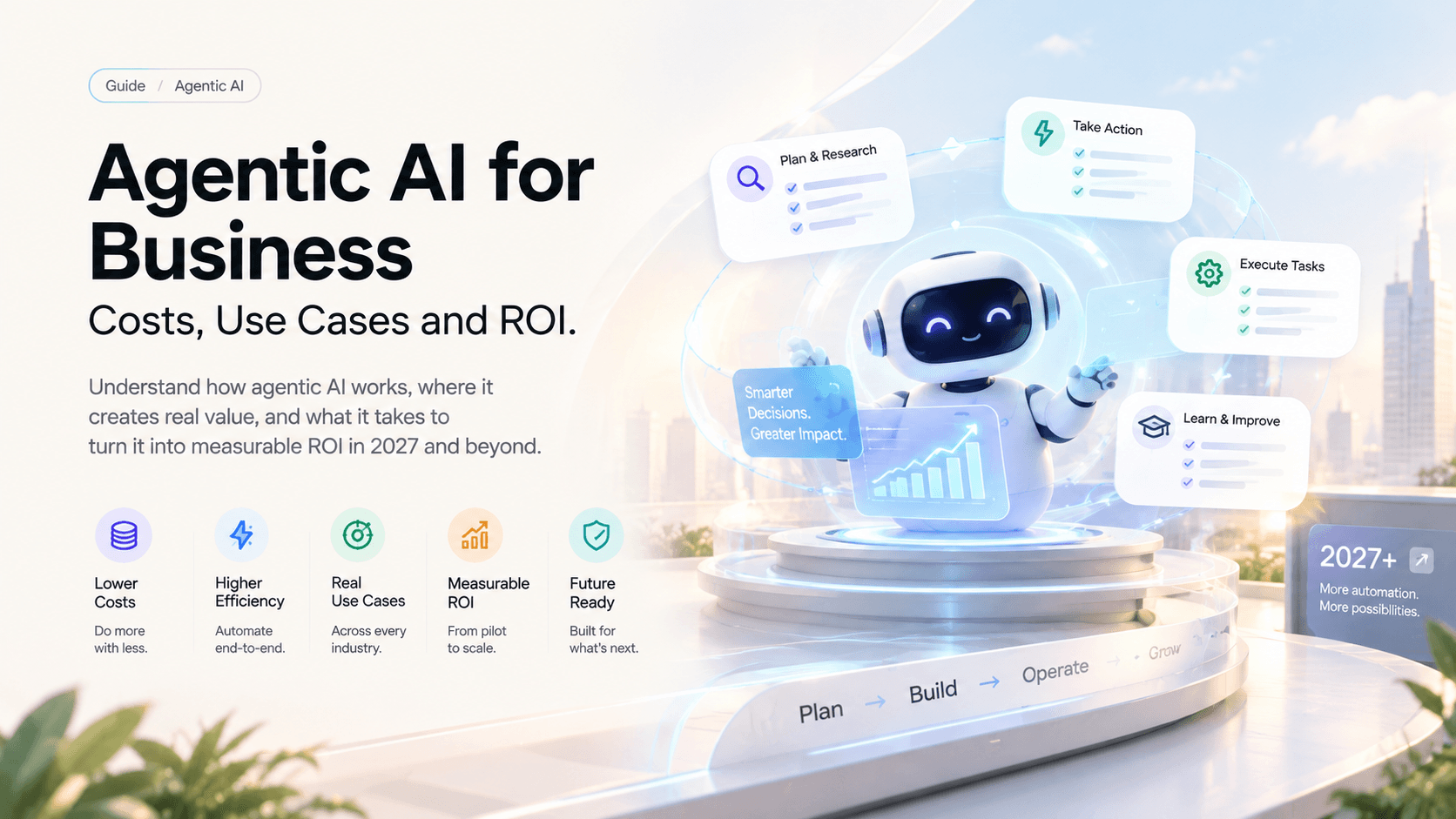
Agentic AI for business means AI agents that don't just answer questions but complete multi-step work on your behalf: reviewing invoices, following up leads, triaging support tickets, or drafting campaigns, with a human approving what matters. Start with one high-volume, rule-heavy workflow, measure time saved, then expand. Off-the-shelf agents cost from free to a few hundred dollars a month; a custom agent built around your own systems typically costs $25,000 to $100,000 and pays back fastest where volume is high.
A year ago, most businesses were asking "what can AI write for us?" Today they're asking a different question: "what can AI do for us?"
This guide is for owners, founders and team leads in the US and UK who want to understand agentic AI for business without the hype: what AI agents are, where they work, what they cost, how to measure ROI, how to stay compliant, and how to roll them out without becoming one of the projects that gets cancelled.
Search demand has shifted from "what is AI" to "AI that does the work."
What Is Agentic AI?
Agentic AI is AI that can pursue a goal across several steps, using tools and data, with limited supervision. A chatbot waits for a question and gives an answer. An AI agent is given a job, then plans the steps, uses your software, checks its own work and comes back with the job done, or with a decision for you to approve.
Every AI agent has four parts:
A model that reasons and writes, such as Claude, GPT, Gemini or an open-weight model like Mistral
Tools and connectors that let it act, such as your CRM, inbox, accounting software, store or database
Memory and context about your business: your products, tone, rules and history
Guardrails that decide what it can do alone and what needs a human's approval
AI agents vs chatbots vs AI automation
Chatbot | Traditional AI automation | AI agent | |
What it does | Answers questions | Runs fixed, pre-built steps | Plans and completes multi-step tasks |
Handles messy inputs | Partly | No, breaks on exceptions | Yes |
Uses your tools | Rarely | Yes, through rigid rules | Yes, and chooses which to use |
Best for | FAQs | Predictable, repetitive processes | Work that needs judgment within clear limits |
Autonomous AI agents sit at the far end of this scale, running continuously in the background, such as monitoring accounts or following up leads around the clock. Most businesses should start with supervised agents and earn their way to autonomy.
Why 2027 Is the Year Agentic AI Goes Mainstream
Spending is moving to agents. Gartner forecasts agentic AI spending of $201.9 billion in 2026, up 141%, and expects it to overtake chatbot and assistant spending for the first time in 2027.
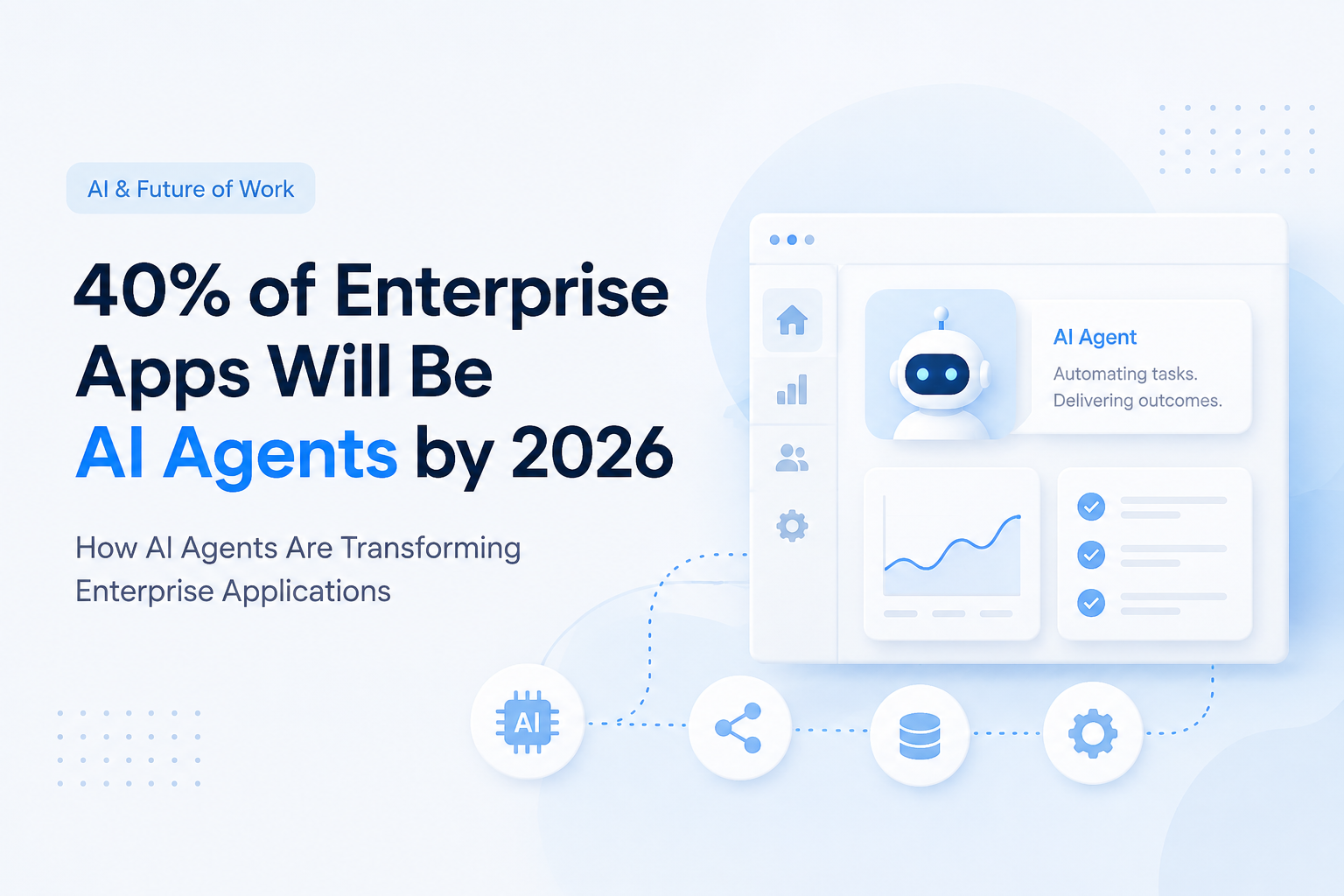
Agents are being built into the software you already use. Gartner projects 40% of enterprise applications will feature task-specific AI agents by the end of 2026, up from less than 5% in 2025.
Every major platform shipped agents this autumn. Meta launched Muse for Small Business, OpenAI launched always-on agents called Dots, Microsoft added Hooks to Copilot Studio, Google introduced Gemini Skills, and SAP expanded Joule across business functions.
Budgets are waiting. Forrester predicts enterprises will push 25% of planned AI spend into 2027 because only 15% of AI decision-makers saw an EBITDA lift. That money comes back in 2027, but with CFOs asking for proof.
The gap is execution. In the US, 76% of small businesses use AI, but only 14% say it is fully embedded in their core operations (Goldman Sachs, 2026). In the UK, 25% of businesses use AI, and only 7% of adopters use agentic AI (ONS, DSIT). The businesses that close that gap first will feel it in their margins.
AI Agents for Business: Use Cases by Department
The best AI agent use cases share three traits: high volume, clear rules, and a cost you can measure. Think of each one as an AI workflow: a repeatable process the agent runs from trigger to result. Here's where agents are already earning their keep.
Where AI agents for business deliver first.
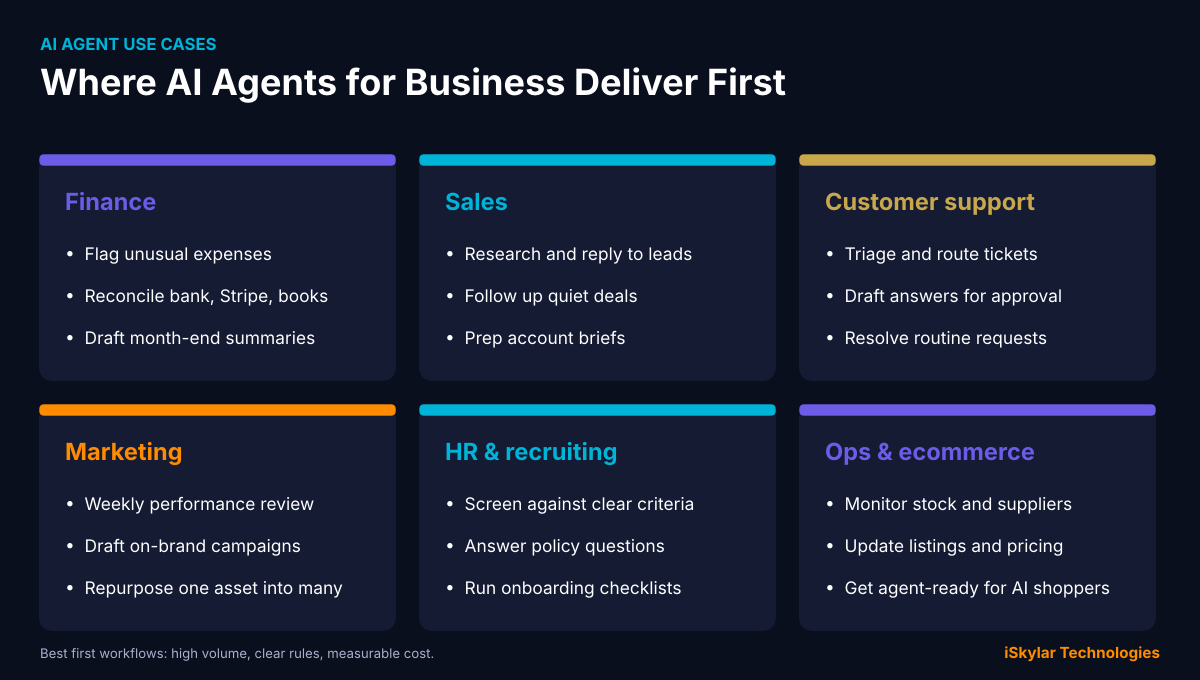
Finance
Flag unusual expenses and duplicate invoices before they're paid
Reconcile transactions between your bank, Stripe and accounting software
Draft month-end summaries and cash-flow notes for review
Sales
Research inbound leads and draft personalised first replies
Follow up quiet deals and update the CRM automatically
Prepare account briefs before every sales call
Customer support
Triage and route tickets by urgency and topic
Draft answers from your knowledge base for an agent to approve
Resolve routine requests such as order status or address changes end to end
Marketing
Review ad and content performance weekly and suggest what to change
Draft campaigns and social posts in your brand voice
Turn one webinar or report into a month of content
HR and recruiting
Screen applications against clear criteria and schedule interviews
Answer employee policy questions from your handbook
Run onboarding checklists across IT, payroll and training
Operations and ecommerce
Monitor stock, suppliers and delivery exceptions
Update product listings and pricing across channels
Prepare your store for agentic commerce (more on that below)
The AI Agent Tools Businesses Are Using Now
You don't have to build from scratch to start. These are the agent platforms that launched or expanded in the last few weeks, and where each one fits.
Tool | What it's good at | Best fit |
Meta Muse for Small Business | Connects to Instagram, Facebook, Meta ads, Shopify, Stripe, QuickBooks, Slack, Canva, Notion and more; drafts growth plans, flags expenses, drafts replies | Small businesses selling online and advertising on Meta |
OpenAI Dots | Always-on agents that connect to 4,000+ apps and work through ChatGPT, Slack and Teams | Teams wanting background agents for ongoing tasks |
Microsoft Copilot Studio | Build agents inside Microsoft 365; new Hooks make agent workflows trigger more reliably | Businesses that run on Outlook, Teams and SharePoint |
Google Gemini Skills | Reusable instructions and files that automate repeat tasks; replaces Gems | Google Workspace users with repeatable writing and analysis tasks |
SAP Joule | Agents across finance, supply chain and HR inside SAP | Larger enterprises already on SAP |
Custom AI agent | Built around your own systems, data, rules and compliance needs | Core, customer-facing or high-volume workflows |
Availability and features vary by country and plan and change often, so check each vendor's current terms before you commit. Pricing ranges from free tiers (Muse is free up to a usage limit, then $20 to $100 a month) to enterprise licences.
How Much Do AI Agents Cost?
AI agent cost depends on whether you rent a platform or build your own.
Option | Typical cost | Watch out for |
Built-in agents in tools you already pay for | Often included or a small add-on | Limited to that vendor's ecosystem |
Off-the-shelf agent platforms | Free tiers to a few hundred dollars a month per user or workspace | Usage-based pricing that climbs with volume |
Custom workflow agent | $4000 – $20,000 to build, plus hosting and model usage | Needs a clear workflow and owner |
Multi-agent system | Well above $20,000 | Only worth it once single agents are proven |
Running costs are falling fast. Small, specialised "decision models" that route tickets or pick the next step now cost as little as $0.04 per million input tokens, which means a well-designed agent can use cheap models for routine steps and save premium models for hard reasoning. That design choice is one of the biggest levers on long-term cost.
How to Measure AI Agent ROI
With CFOs now involved in AI decisions, agentic AI ROI is the question that unlocks budget. Keep the formula simple:
Monthly ROI = (hours saved × loaded hourly cost) + errors avoided + revenue gained − monthly running cost
Illustrative example: a support agent that drafts replies saves your team 120 hours a month. At a loaded cost of $40 an hour, that's $4,800. Faster responses recover an estimated $1,000 in churn. Running cost is $600. Net monthly value: about $5,200. A $30,000 custom build pays back in roughly six months.
Three rules make ROI numbers credible:
Measure a baseline first. Time per task, error rate and volume before the agent goes live.
Count review time. If a person spends 10 minutes checking a 15-minute task, you saved 5 minutes, not 15.
Report monthly. Track the same three numbers every month: time saved, quality, and cost.
Why AI Agent Projects Fail (and How to Avoid It)
Gartner predicts more than 40% of agentic AI projects will be cancelled by the end of 2027. The reasons are predictable:
Building for the buzzword. An impressive demo that doesn't change daily work.
Do-everything agents. One agent spread across sales, support and HR, weak at all of them.
Poor integration. The agent can't reach the systems where the work actually happens.
No owner and no metrics. Nobody is accountable, so nobody can prove value.
Costs that grow faster than value. Expensive models used for every step, every time.
The projects that survive do the opposite: one workflow, one owner, real integration, clear guardrails and monthly measurement.
Where to Start: The AI Agent Decision Matrix
Match your first workflow to the right type of agent.
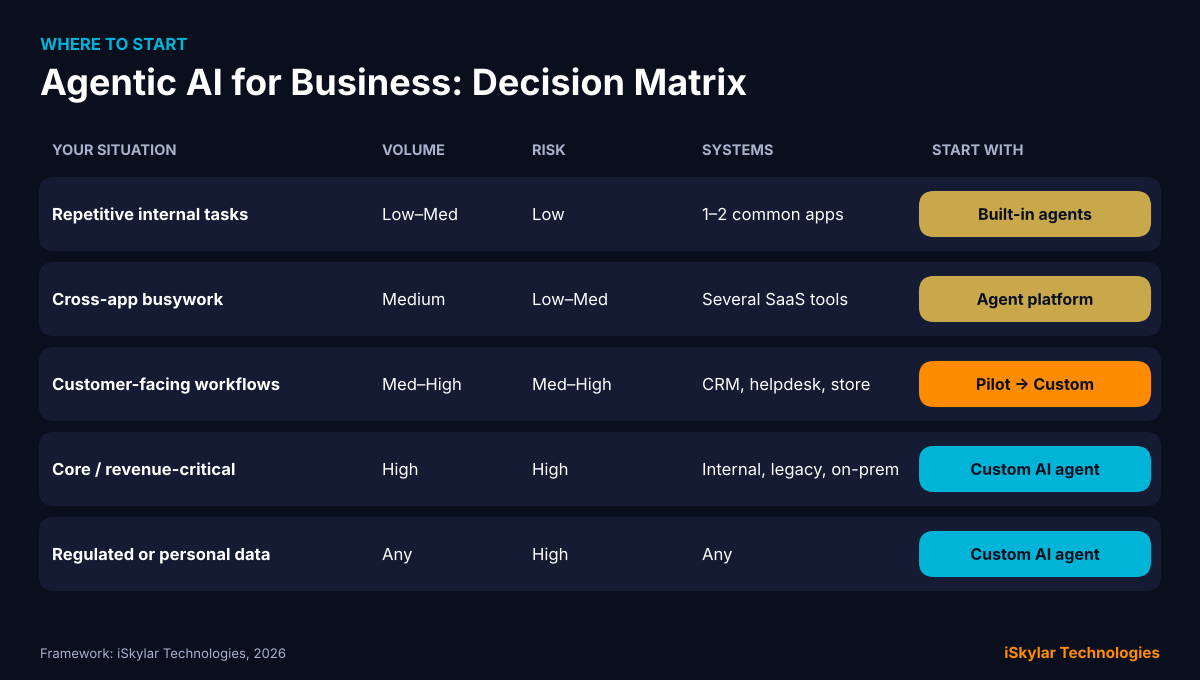
Your situation | Volume | Risk if it goes wrong | Systems involved | Start with |
Repetitive internal tasks | Low–Medium | Low | One or two common apps | Built-in agents in tools you already use |
Cross-app busywork | Medium | Low–Medium | Several SaaS tools | Off-the-shelf agent platform |
Customer-facing workflows | Medium–High | Medium–High | CRM, helpdesk, store | Off-the-shelf pilot, then custom |
Core or revenue-critical processes | High | High | Internal systems, legacy or on-prem | Custom AI agent |
Regulated data (finance, health, personal data) | Any | High | Any | Custom AI agent with full audit and controls |
If you're weighing renting against building, our guide to no-code vs custom AI agents covers the breakeven math in detail.
AI Agent Security and Governance: A Simple Checklist
Gartner lists agentic AI oversight as the number-one cybersecurity trend for 2026. Good AI agent governance doesn't need a dedicated department. These basics cover most of the risk:
Least privilege. Give each agent access only to the data and tools its job needs.
Human approval for anything irreversible. Sending, publishing, paying and deleting should need a yes.
Spending limits. Cap what an agent can spend per transaction and per month.
Audit logs. Record what the agent saw, decided and did.
Prompt injection defences. Treat emails, web pages and documents the agent reads as untrusted input.
A named owner. One person accountable for each agent's performance and behaviour.
AI Agents, the EU AI Act and UK GDPR
If you serve customers in the UK or EU, compliance is part of the design, not an afterthought.
EU AI Act transparency rules have applied since 2 August 2026. People must be told when they're interacting with an AI system, and AI-generated content must be labelled. The watermarking grace period for systems already deployed ends on 2 December 2026.
High-risk obligations now start on 2 December 2027. They were pushed back from August 2026, which makes 2027 the year to plan, not the year to relax.
UK GDPR still applies to any agent handling personal data. That means a lawful basis, data minimisation, clear records of processing, and care around automated decisions that significantly affect people.
In practice: tell customers when they're talking to an agent, keep a human in the loop for decisions about people, log everything, and keep personal data in systems you control. This is not legal advice; involve your legal or data protection lead for your specific case.
Agentic Commerce: When AI Agents Start Shopping
The next wave isn't just agents working for you. It's agents buying from you on behalf of your customers.
Mastercard Agent Pay is live for all US cardholders.
Visa is running live agentic transactions with around 30 European issuers.
AI-referred traffic to US retail sites converted 60% better than other traffic by July 2026 (Adobe).
To get your store agent-ready, make product data clean and structured, keep pricing and stock accurate in real time, publish clear policies an agent can read, and make sure your checkout and payment provider support agent-initiated payments.
Your 90-Day Agentic AI Rollout Plan
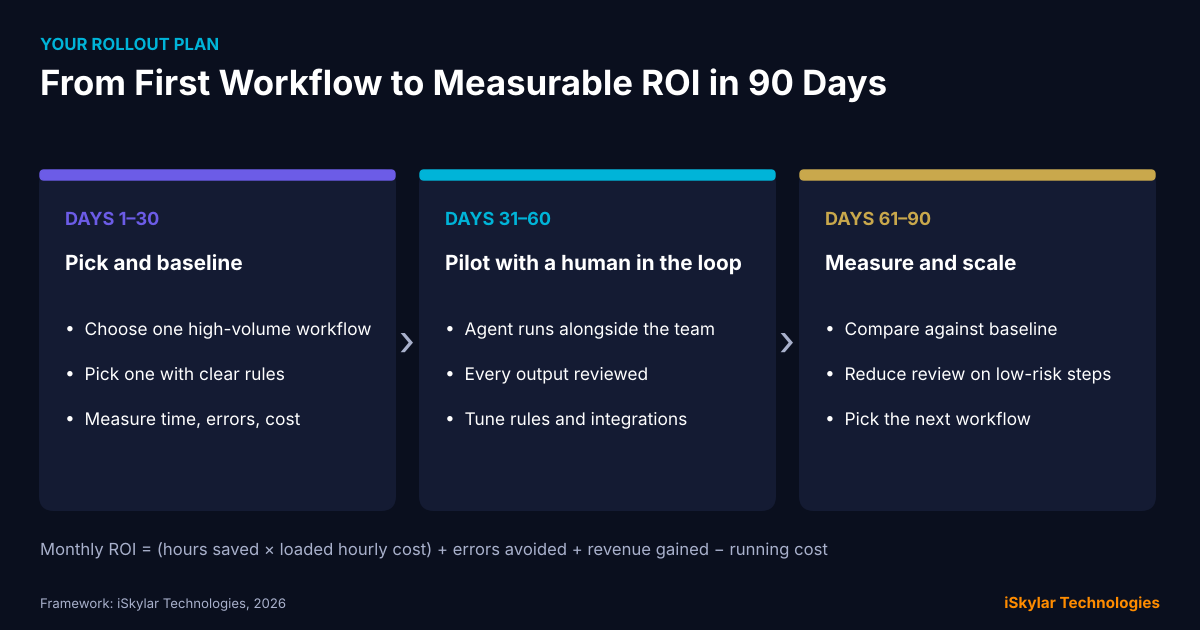
A 90-day path from first workflow to measurable results.
Days 1–30: Pick and baseline. Choose one high-volume, rule-heavy workflow. Measure how long it takes today, how often it goes wrong, and what it costs.
Days 31–60: Pilot with a human in the loop. Run the agent alongside your team. Every output gets reviewed. Tune prompts, rules and integrations.
Days 61–90: Measure and scale. Compare against your baseline. If it's working, reduce review on low-risk steps and pick the next workflow.
Build Your First AI Agent With iSkylar
iSkylar Technologies is an AI-first software development company headquartered in Jaipur, with offices in Bangalore and Quincy, Massachusetts, serving businesses across the US, UK, Canada, Australia and the UAE.
We help businesses move from "we should do something with AI agents" to agents running in production:
Workflow discovery. We find the one or two workflows where an agent pays back fastest.
Set up or build. We configure off-the-shelf agents where they fit, and build custom AI agents where they don't.
Integrate with your stack. CRMs, helpdesks, accounting tools, ecommerce platforms, internal databases and legacy systems.
Governance built in. Approvals, spend limits, audit logs and data controls designed for US and UK requirements.
Cost-smart architecture. The right model for each step, so running costs stay low as volume grows.
Learn more about why companies partner with iSkylar Technologies.
Start With One Workflow. Prove It. Then Scale.
Agentic AI for business isn't about replacing your team or chasing every new launch. It's about finding the work that drains hours every week and giving it to an agent that does it reliably, safely and cheaply.
The businesses that start in the next few months will have proven agents in production while others are still reading about them.
Talk to iSkylar about your first AI agent. In a 30-minute call we'll identify your highest-payback workflow, estimate the ROI, and show you whether to set up an off-the-shelf agent or build a custom one.
Plan your first AI agent with iSkylar →
WRITTEN BY
Harsh Mangal
Head of Marketing & Growth at iSkylar Technologies, an AI-first software development company. He writes about AI adoption, AI agents and how businesses can put agentic AI to work.
Frequently Asked Questions
What is agentic AI?
What is the difference between an AI agent and a chatbot?
How much do AI agents cost for a business?
What are the best AI agents for business in 2027?
How do I measure the ROI of an AI agent?
Are AI agents GDPR compliant?
Will AI agents replace employees?
How do I get started with AI agents?
Further Reading


Stay at the forefront of innovation.
innovation.
Join our inner circle of industry leaders and get exclusive insights delivered to your inbox every Thursday morning.
WE RESPECT YOUR PRIVACY. NO SPAM, EVER.