
How Much Does It Cost to Build a Home Services App in 2027?
What a home services app really costs in 2027: MVPs from $5,000 in 6 to 8 weeks, cost per feature, a sample launch budget, running costs, and pricing for 6 markets.
Hansraj
PRINCIPAL ARCHITECT10 MIN READ
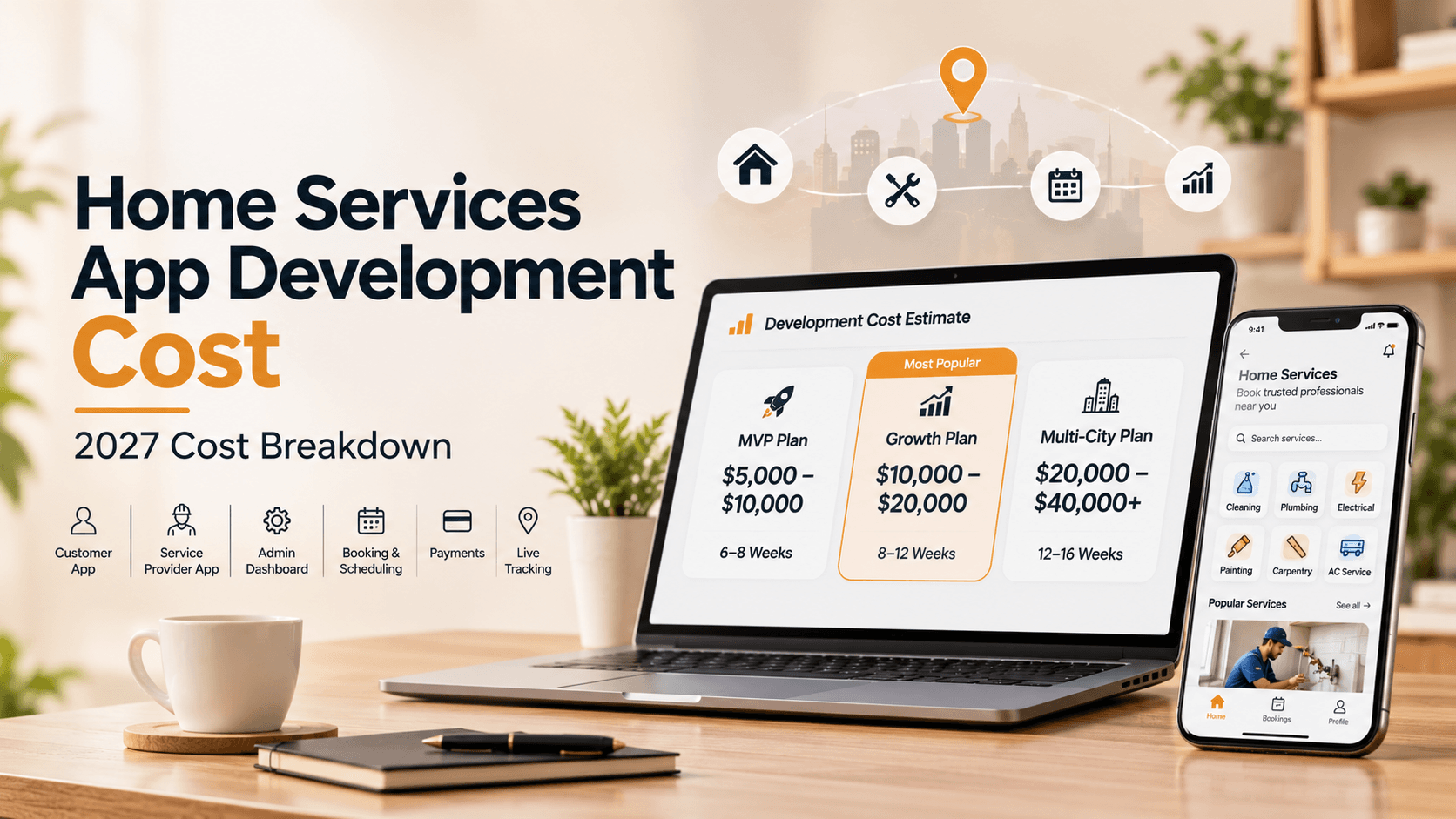
iSkylar builds home services apps with a customer app, a provider app and an admin dashboard. A launch-ready MVP costs $5,000 to $10,000 and takes 6 to 8 weeks. Adding tracking, subscriptions and more categories brings it to $10,000 to $20,000, and a multi-city platform costs $20,000 to $40,000 or more.
Search for home services app development cost and you will find quotes anywhere from $5,000 to $250,000 for what sounds like the same product. The gap is not random. It comes from a handful of specific decisions: whether your prices are fixed or quoted, how your providers get assigned to jobs, what happens when a booking is cancelled, and how many apps you actually need on day one.
This guide is built from the way we scope real home services projects. It shows what each feature costs, what a realistic first budget looks like, and the details that quietly double a budget if nobody plans for them.
How much does a home services app cost in 2027?
A home services app costs $5,000 to $10,000 for an MVP, $10,000 to $20,000 for a growth version, and $20,000 to $40,000 or more for a multi-city platform. Each tier includes the customer app, the provider app and the admin dashboard, built once for both iOS and Android.
Tier | Cost | Timeline | What you launch with |
|---|---|---|---|
MVP | $5,000 to $10,000 | 6 to 8 weeks | One city, fixed-price services, slot booking, card payments, provider app, ratings, notifications, admin dashboard |
Growth | $10,000 to $20,000 | 2 to 3 months | Everything in MVP plus live provider tracking, recurring bookings, service packages, promo codes, multiple categories, Arabic and right-to-left layouts |
Multi-city | $20,000 to $40,000+ | 3 to 5 months | Everything in Growth plus automated dispatch, provider matching by skill and distance, city-level pricing, multi-currency, business accounts and analytics |
The home services app MVP is the right starting point for most founders. It is enough to take real bookings in one city and learn what customers actually reorder before you spend on growth features. If you are still working out the business side, such as pricing, commission and how to recruit providers, read our guide on how to start an on-demand home services business.
Why do some agencies quote $50,000 or more for the same app?
Most of the difference comes from team location, how much is built from scratch and how many native apps are included. A US or UK agency billing $100 to $150 an hour will reach $50,000 on a home services MVP quickly. We keep the same scope at $5,000 to $10,000 by combining an experienced engineering team in India, proven modules for booking, payments and notifications that we have already built and tested, and AI-assisted development for repetitive code and testing. You still own all of the source code, and every feature is shaped around your services rather than copied from a template.
Which decisions change the cost of an on-demand home services app the most?
Four product decisions move the budget more than anything else. Getting them right early is the cheapest way to control cost.
1. Fixed prices or quotes
Fixed-price services, such as a 2-hour apartment clean or an AC service, are the cheapest to build because the customer books and pays in one step. Quote-based jobs, such as plumbing repairs or renovation, need a request flow, provider quotes, customer approval and price changes after inspection. That usually adds $1,500 to $3,000 and two to three weeks. Many founders launch fixed-price categories first and add quotes later.
2. How providers get assigned
Letting the admin team assign jobs manually is the cheapest option and works well for the first few hundred bookings a month. Letting providers accept open jobs costs a little more. Fully automated dispatch, which matches the nearest available provider with the right skill, belongs in the multi-city tier.
3. Cancellation, rescheduling and no-shows
This is the part most budgets forget. Who pays when a customer cancels two hours before a job? What happens when a provider does not turn up? Each rule needs logic, notifications and refund handling. Planning these rules before development starts saves rework later.
4. Cash and card payments
Card-only checkout is the simplest. In markets where customers still pay providers in cash, the app also needs cash collection tracking and provider balance settlement, which adds roughly $800 to $1,500.
These are the same cost drivers we plan for across every on-demand app development project, from cleaning and laundry to beauty and appliance repair.
How much does each feature of a home services app cost?
Most individual features cost between $300 and $2,500. Add up the rows you need to build your own estimate. Every figure includes design, development and testing.
Feature | Cost | Tier |
|---|---|---|
Sign-up, OTP login and profiles for customers and providers | $500 to $900 | MVP |
Service catalog, fixed pricing and search | $400 to $800 | MVP |
Slot booking, scheduling and booking rules | $900 to $1,800 | MVP |
Provider app: job alerts, availability, job status, earnings | $1,200 to $2,200 | MVP |
Card payments, refunds and provider payouts | $900 to $1,600 | MVP |
Push notifications, SMS and in-app chat | $500 to $900 | MVP |
Ratings and reviews for both sides | $300 to $500 | MVP |
Admin dashboard: bookings, providers, payouts, reports | $1,000 to $1,800 | MVP |
Live provider tracking and ETA on a map | $1,200 to $2,500 | Growth |
Recurring bookings and service packages | $800 to $1,500 | Growth |
Multiple categories with their own rules | $800 to $1,500 | Growth |
Arabic and right-to-left layout | $600 to $1,200 | Growth (MVP in the Gulf) |
Promo codes and referral rewards | $400 to $800 | Growth |
Quote-based jobs with provider pricing | $1,500 to $3,000 | Growth |
Automated dispatch and provider matching | $2,500 to $5,000 | Multi-city |
City-level pricing, multi-currency and city admins | $2,000 to $4,000 | Multi-city |
Business accounts and monthly invoicing | $1,500 to $3,000 | Multi-city |
Analytics dashboards for demand, supply and revenue | $1,500 to $3,000 | Multi-city |
The eight MVP rows add up to roughly $5,700 to $10,500. If a quote comes in well below that, check whether the provider app, payouts or admin tools have been left out.
What does a realistic first budget look like?
Here is how a typical first launch is scoped: a home cleaning startup in one city, with around 30 to 50 cleaners and fixed-price services.
Item | Decision | Cost |
|---|---|---|
Core MVP | Customer app, provider app, admin dashboard | $7,500 |
Pricing model | Fixed prices by apartment size and hours | Included |
Job assignment | Admin assigns jobs, cleaners accept in the app | Included |
Recurring bookings | Weekly and fortnightly cleans | $1,000 |
Language | English and Arabic | $800 |
Total | Launch in about 8 weeks | $9,300 |
Recurring bookings are worth adding early for cleaning. A customer who books weekly is worth many one-off bookings, and the feature costs about $1,000.
How much does it cost to build an app like Urban Company, TaskRabbit or Checkatrade?
A launch version of a well-known home services app costs $8,000 to $40,000, depending on its business model. These figures cover a first version with the same core model, not everything these companies have built over many years.
App | Main market | Business model | Launch version cost | Timeline |
|---|---|---|---|---|
Checkatrade | UK | Directory of vetted trades with reviews and quote requests | $8,000 to $15,000 | 6 to 8 weeks |
HomeStars | Canada | Reviews and lead generation for home pros | $8,000 to $15,000 | 6 to 8 weeks |
TaskRabbit | US | Customers book taskers by skill at hourly rates | $12,000 to $25,000 | 2 to 3 months |
Airtasker | Australia | Customers post tasks and providers make offers | $12,000 to $25,000 | 2 to 3 months |
Justlife | UAE and KSA | Instant booking of fixed-price services with managed quality | $15,000 to $30,000 | 2.5 to 4 months |
Munjz | KSA | On-demand home maintenance with assigned technicians | $15,000 to $30,000 | 2.5 to 4 months |
Urban Company | India, UAE, KSA | Multi-category instant booking with trained professionals | $12,000 to $40,000+ | 3 to 5 months |
Directory and lead-generation apps cost the least because they do not run live scheduling or payouts. Instant-booking apps cost the most, because the platform takes responsibility for timing, payment and quality on every job.
Is it cheaper to build native apps or one cross-platform app?
One cross-platform app is almost always cheaper for a home services startup. Agencies building separate native iOS and Android apps often charge $30,000 to $60,000 per platform. With a single Flutter codebase, both the customer and provider apps run on iOS and Android from one build, so you pay once for development and once for every future update. Native apps only make sense later, if you need heavy device features or very high scale.
What does a home services app cost to run every month?
Running a home services app typically costs $200 to $1,500 a month after launch, plus payment processing fees on each booking.
Running cost | Monthly range | What changes it |
|---|---|---|
Cloud hosting and database | $50 to $400 | Number of bookings and cities |
Maps, routing and location | $30 to $300 | Higher once live tracking is switched on |
SMS, OTP login and email | $20 to $200 | Country SMS rates and booking volume |
App store accounts, monitoring and analytics | $20 to $100 | Tools you choose |
Maintenance, fixes and updates | $100 to $600 | Usually 15 to 20% of the build cost per year |
Payment processing | About 2.5 to 3.5% per booking | Country and payment method |
Maintenance is the line most founders skip. New phone models, operating system updates and security patches arrive every year, so it is worth planning app maintenance and support from day one.
How do taxes and local payment methods change the cost in each market?
Each market adds its own tax rules and checkout expectations, and each one adds a small amount of build work.
Market | Tax on services | Payment methods customers expect | Extra build cost |
|---|---|---|---|
United States | Sales tax set state by state; some services are taxable, others are not | Cards, Apple Pay, Google Pay | $300 to $800 for state-based tax rules |
United Kingdom | VAT at 20% once you pass the registration threshold | Cards with Strong Customer Authentication, Apple Pay, Google Pay | $200 to $500 for VAT invoices |
UAE | VAT at 5% | Cards, Apple Pay, Tabby and Tamara buy-now-pay-later, cash | $600 to $1,500 for Arabic and buy-now-pay-later |
Saudi Arabia | VAT at 15% | mada cards, Apple Pay, STC Pay, Tabby and Tamara | $800 to $1,800 for Arabic-first design and mada |
Canada | GST or HST from 5% to 15%, depending on the province | Cards, Interac, Apple Pay | $300 to $800, more with French for Quebec |
Australia | GST at 10% | Cards, Apple Pay, Afterpay | $200 to $600 for GST pricing and Afterpay |
The cheapest approach is to launch in one market but build prices, tax rates and languages as settings instead of hard-coded rules. A second country then takes weeks, not months.
What does a real home services app build look like?
Our home services app development case study shows the full build in practice: a customer app for booking trusted local professionals, a provider app for managing jobs and earnings, and an admin dashboard for running the whole operation. It follows the same approach described in this guide, starting with a focused MVP and adding features once real booking patterns are clear.
The tech stack is the one we recommend for most home services platforms because it is quick to build and simple to scale: Flutter for the customer and provider apps, Node.js for the backend, PostgreSQL for bookings and payments, Google Maps for location and routing, Firebase for push notifications and AWS for hosting.
Get an exact estimate for your home services app
The quickest way to a reliable budget is to map your own services, pricing model and markets. Get your estimate in a few minutes, or book a demo and we will scope your first launch with you.
WRITTEN BY
Hansraj
Leads marketing, growth and go-to-market strategy at iSkylar, helping founders scope and launch on-demand and marketplace apps.
Frequently Asked Questions
How much does a home services app MVP cost?
How long does it take to build a home services app?
Why do quotes for the same home services app range from $5,000 to $250,000?
Is a clone script cheaper than a custom home services app?
What does it cost to run a home services app every month?
What payment methods should a home services app support?
Do I need separate customer and provider apps?
Further Reading



Stay at the forefront of innovation.
innovation.
Join our inner circle of industry leaders and get exclusive insights delivered to your inbox every Thursday morning.
WE RESPECT YOUR PRIVACY. NO SPAM, EVER.
Updated At: