
Telemedicine App Development Cost in 2027: Features, Timelines and Compliance by Country
Telemedicine app development costs $12K to $55K for an MVP and up to $250K+ for AI-enabled, multi-site platforms. See feature-level costs, timelines, running costs and the HIPAA, UK, UAE, Saudi, Canada and Australia compliance rules you must build for in 2027.
Harsh Mangal
PRINCIPAL ARCHITECT9 MIN READ
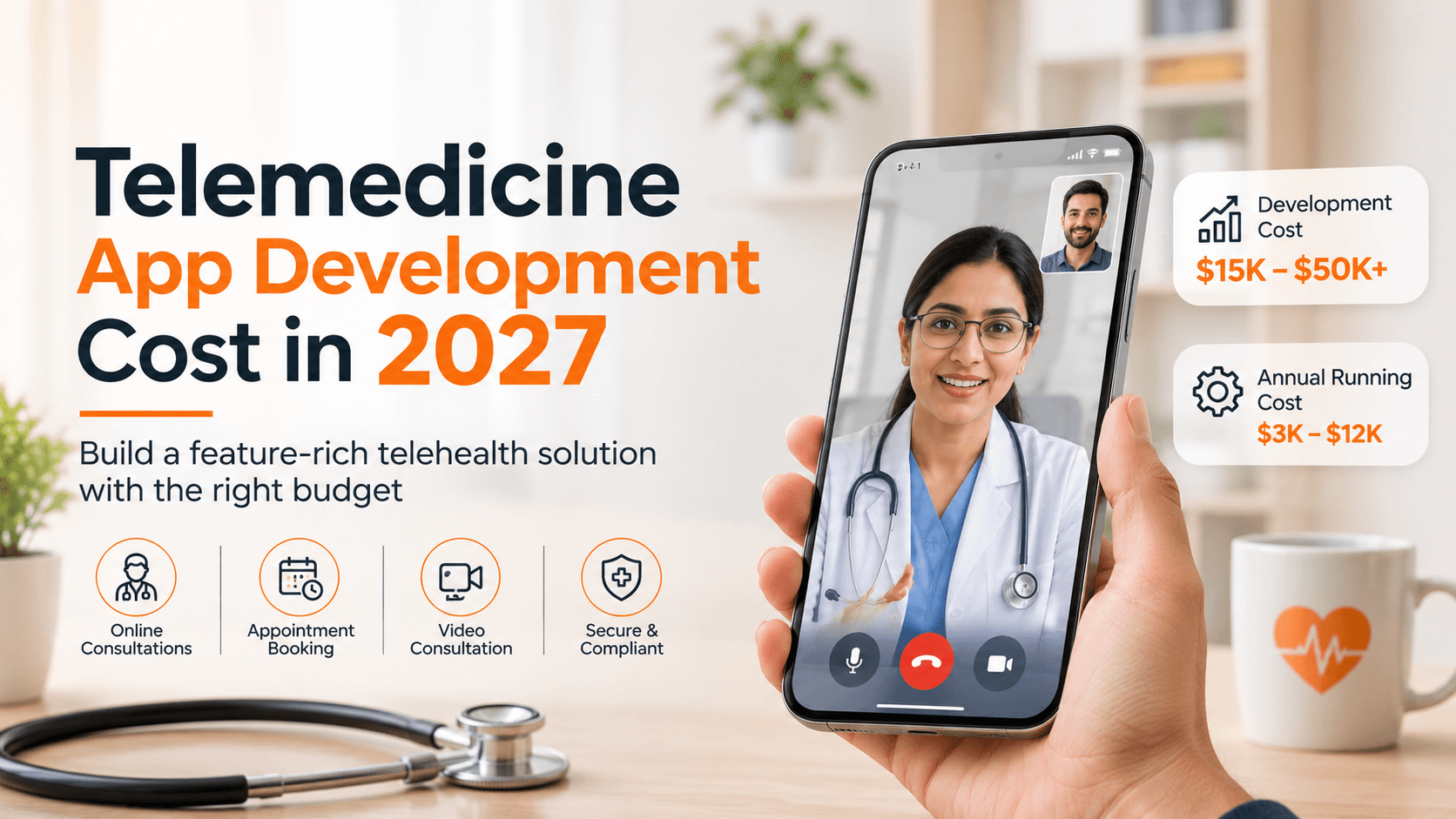
Telemedicine app development costs $12,000 to $55,000 for an MVP with booking and video consultations, $18,000 to $120,000 for a full platform with EHR integration, e-prescriptions and payments, and $30,000 to $250,000+ for an AI-enabled, multi-site or remote patient monitoring platform. Expect 14 to 18 weeks for an MVP and 20 to 28+ weeks for a full platform. Compliance (HIPAA, UK GDPR, UAE and Saudi data residency) typically adds 10% to 20% to the budget.
Telehealth has moved from emergency workaround to permanent infrastructure. Grand View Research projects the global telemedicine market will reach about $157.9 billion in 2026, growing at roughly 18% a year toward $514 billion by 2033. In the US, Congress extended Medicare's telehealth flexibilities through December 31, 2027, and in the Gulf, Dubai's updated telehealth standard took effect in November 2025.
So the question for clinics, hospital groups and health startups is no longer "should we build a telemedicine app?" but "what will it cost, and what must it include to be legal in our market?" This guide answers both, with 2027 pricing, feature-level costs, timelines and country-by-country compliance for the USA, UK, UAE, Saudi Arabia, Canada and Australia.
Telemedicine App Development Cost at a Glance (2027)
Tier | What's Included | Cost | Timeline |
|---|---|---|---|
MVP / single clinic | Patient and doctor apps, booking, video and chat consults, reminders, payments, admin panel, core security | $12,000 to $55,000 | 14 to 18 weeks |
Full telehealth platform | Everything in MVP plus EHR integration (HL7/FHIR), e-prescriptions, insurance checks, intake forms, analytics, web portal | $18,000 to $120,000 | 20 to 28 weeks |
AI-enabled / multi-site / RPM | Multi-provider networks, AI triage and clinical notes, remote patient monitoring with wearables, multilingual, advanced reporting | $30,000 to $250,000+ | 28 to 40 weeks |
These ranges reflect a senior offshore team with India-based rates. US and UK agencies commonly quote $100,000 to $300,000+ for comparable scope.
Types of Telemedicine Apps and Their Cost
Real-time (synchronous) consultation apps: video, voice and chat visits with doctors. The most common model, $10,000 to $120,000.
Store-and-forward (asynchronous) apps: patients upload photos, forms or test results for later review, popular in dermatology and radiology. $15,000 to $90,000.
Remote patient monitoring (RPM): connected devices such as glucose meters and blood pressure cuffs stream data to care teams. $20,000 to $200,000+.
Specialty platforms: mental health, chronic care, women's health or weight management apps with care plans, content and subscriptions. $20,000 to $180,000.
Hospital telehealth modules: virtual clinics added to an existing hospital system or hospital management system, priced by integration depth.
Feature-Level Cost Breakdown
Feature | Estimated Cost | Notes |
|---|---|---|
Registration, login, MFA and profiles | $1500 to $6,000 | Patient, doctor and admin roles; national ID or UAE Pass / Nafath login in the Gulf |
Doctor search, availability and booking | $1,000 to $10,000 | Specialty, language, insurance and location filters; time zones |
Video, voice and secure chat | $4,000 to $15,000 | WebRTC or a HIPAA-eligible video SDK, virtual waiting room, file sharing |
Reminders and notifications | $1500 to $4,000 | SMS, email, push and WhatsApp where permitted |
Payments and insurance | $3,000 to $12,000 | Card payments, co-pays, eligibility checks, claims export |
E-prescriptions | $3,000 to $15,000 | Surescripts in the US, national e-prescribing services elsewhere |
EHR / EMR integration | $8,000 to $30,000 per system | Epic, Cerner (Oracle Health), athenahealth via FHIR R4 or HL7 v2 |
Doctor dashboard and clinical notes | $4,500 to $12,000 | Schedules, patient history, SOAP notes, follow-ups |
Admin panel and analytics | $5,000 to $12,000 | Provider management, utilisation, no-shows, revenue |
AI features | $8,000 to $50,000 | Symptom triage, AI scribe notes, no-show prediction, multilingual chatbot |
Security and compliance work | $6,000 to $25,000 | Encryption, audit logs, access controls, risk assessments, penetration test |
What Drives Telemedicine App Cost?
Integrations: EHR, labs, pharmacy and insurance integrations are the single biggest variable. Each one adds weeks of mapping and testing.
Platforms: iOS, Android and web together cost more than one platform. Cross-platform frameworks such as Flutter reduce this by 25% to 40%.
Compliance scope: HIPAA in the US, DTAC and DSPT for NHS buyers in the UK, and data localisation in the UAE and Saudi Arabia each add design, hosting and documentation work.
Video volume: per-minute video SDK fees vs self-hosted WebRTC infrastructure changes both build and running cost.
AI and medical device status: features that diagnose or recommend treatment may be regulated as software as a medical device (SaMD) by the FDA, MHRA, SFDA, Health Canada or TGA, which adds clinical validation cost.
Languages: Arabic and English with right-to-left layouts is mandatory in the Gulf and adds roughly 10% to 15% to UI work.
Telemedicine Compliance by Country (2026 to 2027)
Compliance is where most telemedicine budgets go wrong. Competitor cost guides usually mention HIPAA and stop. If you serve patients outside the US, design for these rules from day one.
Country | Key Regulations | Build Impact |
|---|---|---|
USA | HIPAA and HITECH, state licensure, Medicare telehealth flexibilities extended to Dec 31, 2027 (Consolidated Appropriations Act, 2026), DEA telemedicine prescribing flexibilities running to Dec 31, 2026 with a permanent special registration rule pending | BAAs with every vendor, audit logs, state-based doctor matching, controlled-substance prescribing logic that can change quickly |
UK | UK GDPR, CQC registration for providers, NHS DTAC (refreshed form in use from April 6, 2026), DCB0129 clinical safety, DSPT, MHRA rules for software medical devices | Clinical safety case and hazard log, Clinical Safety Officer, NHS login and GP Connect if selling to the NHS |
UAE | Federal Law No. 2 of 2019 (health data, Article 13 localisation), DHA Telehealth Standard (version effective Nov 26, 2025), DOH Abu Dhabi and MOHAP rules, PDPL | UAE-hosted servers, Arabic and English UI, e-consent before each consult, integration with NABIDH, Malaffi or Riayati, 25-year record retention |
Saudi Arabia (KSA) | MOH telehealth regulations and licensing, Saudi PDPL and cross-border transfer rules, NCA cybersecurity controls, SFDA rules for digital health products, NPHIES for insurance claims | Video required for teleconsultations, in-Kingdom hosting for sensitive data, Nafath login, Arabic-first UX, NPHIES integration for insured patients |
Canada | PIPEDA, provincial health privacy laws (PHIPA in Ontario, HIA in Alberta, Quebec Law 25), provincial licensure | Canadian data hosting is often expected by provinces and buyers, privacy impact assessments, province-based doctor matching |
Australia | Privacy Act 1988 and APPs, AHPRA telehealth guidance, Medicare telehealth rules (established clinical relationship), TGA rules for software as a medical device, My Health Record | Consent and privacy notices, Medicare eligibility logic, ePrescribing tokens, local hosting preferred |
This is general information, not legal advice. Confirm requirements with qualified healthcare counsel in each market.
The UAE and Saudi Opportunity
The Gulf is one of the fastest-moving telehealth markets. According to Saudi Arabia's Ministry of Health (August 2026), SEHA Virtual Hospital connects 241 hospitals and more than 1,400 health centres, and the Sehhaty app passed 31 million users in 2025. Meanwhile, the UAE now requires licensed telehealth providers to integrate with emirate health information exchanges. For a regional platform, plan for $15,000 to $40,000 on top of a standard build for local hosting, Arabic RTL design, UAE Pass or Nafath login, health information exchange integration and NPHIES claims.
Monthly Running Costs After Launch
Cost Item | Typical Monthly Range |
|---|---|
Cloud hosting (HIPAA-eligible or in-country) | $400 to $3,000 |
Video consultation minutes | $200 to $4,000 depending on volume |
SMS, email, push and WhatsApp | $50 to $800 |
Third-party APIs (e-prescribing, eligibility, maps) | $200 to $2,000 |
AI model usage (triage, scribe) | $100 to $2,500 |
Maintenance, security patches and support | 15% to 20% of build cost per year |
Development Timeline: 14 to 28 Weeks
Discovery and compliance mapping (2 to 3 weeks): care pathways, target markets, regulatory checklist, integration list.
UX/UI design (3 to 4 weeks): patient, doctor and admin journeys, accessibility (WCAG), Arabic RTL if needed.
Core development (8 to 14 weeks): booking, video, chat, payments, prescriptions, dashboards.
Integrations (3 to 8 weeks, in parallel): EHR, labs, pharmacy, insurance, national ID login.
Security testing and clinical safety (2 to 3 weeks): penetration testing, risk assessment, UAT with clinicians.
Launch and hypercare (ongoing): phased go-live, monitoring, 90-day support window.
AI Features Worth Adding in 2027
AI medical scribe: drafts SOAP notes from the consultation for doctor review, saving minutes per visit.
Symptom triage: routes patients to the right specialty or urgency level before booking.
No-show prediction: flags high-risk appointments and triggers extra reminders or waitlist filling.
Multilingual assistant: Arabic, English, Hindi or Urdu chat for booking and FAQs, built with our AI chatbot development team.
Keep a clinician in the loop. Any AI feature that diagnoses or recommends treatment may be classified as a medical device, and some US states now restrict AI-only therapy chatbots.
How to Reduce Telemedicine App Development Cost
Launch an MVP for one specialty and one market, then expand.
Use a cross-platform framework for iOS and Android.
Use proven, compliant video and messaging SDKs instead of building from scratch.
Integrate with one EHR first, using FHIR where possible.
Work with an offshore team experienced in healthcare compliance to cut labour cost by 40% to 60%.
Build Your Telemedicine App with iSkylar
iSkylar builds doctor appointment and telemedicine apps with HIPAA-ready architecture, AES-256 encryption, immutable audit logs and EHR integration with Epic, Cerner, athenahealth and others. Our Growth package starts from $30,000 for a focused scheduling and consultation system delivered in 14 to 18 weeks, and full platforms with AI no-show prediction, triage and telemedicine take 20 to 28 weeks. Every engagement includes a BAA, full source code ownership and 90-day hypercare.
Get a Fixed-Scope Telemedicine Quote
Tell us your specialty, target countries and integrations, and we will send a fixed-scope estimate with a compliance checklist for your market. Talk to iSkylar's healthcare app team.
WRITTEN BY
Harsh Mangal
Having 8+ years of experience helping founders across the US, UK, Middle East and Australia plan, budget and launch on-demand platforms.
Frequently Asked Questions
How much does it cost to develop a telemedicine app in 2027?
How long does it take to build a telehealth app?
How much does a HIPAA-compliant telemedicine app cost?
What does it cost to build a telemedicine app in the UAE or Saudi Arabia?
What features does a telemedicine app need?
Can I build a telemedicine app like Teladoc or Practo?
Are telehealth rules in the US changing in 2027?
How much does it cost to maintain a telemedicine app?
Further Reading




Stay at the forefront of innovation.
innovation.
Join our inner circle of industry leaders and get exclusive insights delivered to your inbox every Thursday morning.
WE RESPECT YOUR PRIVACY. NO SPAM, EVER.
Updated At: